All products

Solver

SolvSRK for Self-Regulating Control

Controllers that know how confident they are.

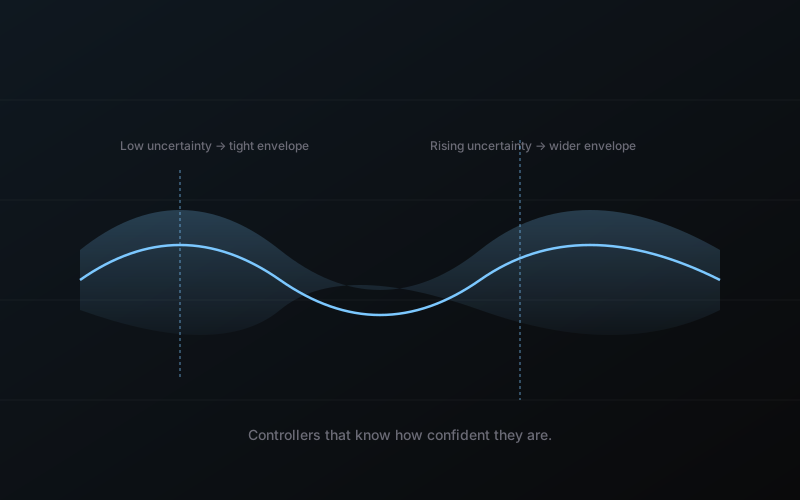
A controller that can measure its own uncertainty can run tighter when the data is clean and back off when the data is noisy. SolvSRK makes that possible by solving the physics and tracking the uncertainty in one computation.

Control loop diagram with a self-adjusting envelope representing adaptive margins.

Imagine yourself in these moments. Same product, different industries.

Chemical process plant

The tuning that never ends.

A chemical plant feed composition shifts. Not catastrophically — just enough that the controller tuning from last quarter is no longer optimal. Yields drift a half percent. Then a percent. A control engineer notices a month later. She schedules a maintenance window to re-tune. Production pauses. The new tuning lasts until the next feed shift. Rinse, repeat.

A controller that knows its own uncertainty does not need quarterly tuning. It tightens when the data is clean and widens when it is not. It adapts continuously instead of catastrophically. The tuning engineer becomes an exception handler, not a full-time job.

Autonomous vehicles

The margin that costs speed.

An autonomous delivery vehicle running through a city. Today its planner carries a fixed safety margin — the worst case it has to handle under the noisiest sensor data, the heaviest rain, the densest pedestrians. That margin is always on. Even on a clear sunny day on a quiet road.

Imagine a planner that knows exactly how much uncertainty it is facing right now and tightens its margin when the data is good. The vehicle moves faster when it is safe to and more cautiously when it is not, automatically. Average delivery time drops. Safety margins get tighter where the math says it is safe and wider where the math says it is not.

Robotic surgery

The tremor that was not a tremor.

A surgical robot. The surgeon’s hand has a tremor; the robot’s job is to filter it out and deliver a steady tool motion. Under clean conditions, the robot is allowed to move quickly. Under noisy conditions — electrocautery interference, a patient moving unexpectedly — the robot has to slow down and hold tighter. Today that distinction is made by a human watching a screen and pressing a button. Tomorrow the control loop makes it on its own because it knows its own confidence.