All products

Application

Bounded Network Enrichment for Card Authorization

Fewer false declines. More fraud caught. Same rules engine.

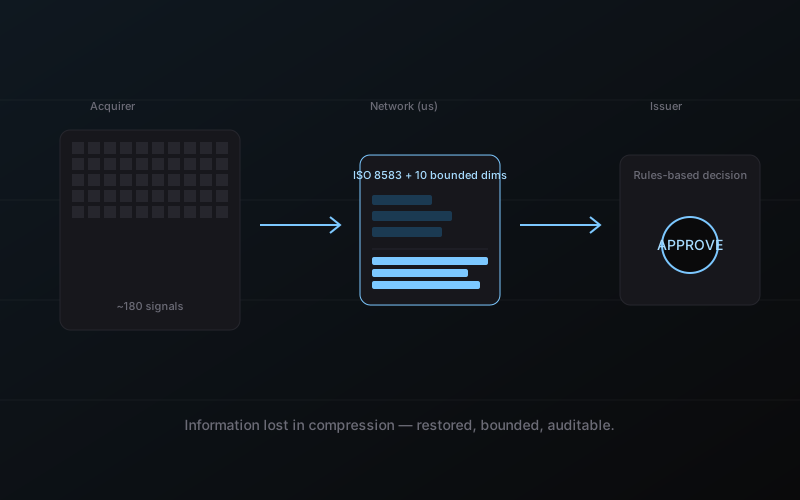
Card networks compress transactions down to twenty fields before the issuer decides. We sit on the network, extract ten bounded intelligence signals from the full picture, and deliver them alongside the standard message. Banks running rules engines outperform banks running machine learning — with a tenth of the regulatory exposure.

Compressed and enriched transaction streams flowing into an issuing bank decision.

Imagine yourself in these moments. Same product, different industries.

Consumer banking

The doctor’s referral.

A patient pays a $300 consultation fee on her credit card. The doctor refers her to a specialist, $1,800. Different merchant. Same patient, same day. To the card network, these look like two independent transactions. The second gets declined as suspicious: unusual dollar amount, unusual merchant category. The patient scrambles to re-submit on a different card. The specialist’s office is confused. Nobody is happy.

The network actually knows these are related. It just throws away the information during the 180→20 field compression that happens before the message reaches the bank. Bounded Network Enrichment restores ten signals that the bank can act on, within the existing message, within the authorization SLA, within auditable bounds.

Shared households

The college kid at a gas station in Ohio.

A card is tied to a parent in Connecticut. The college kid takes it to school. Every gas station charge in Ohio triggers a fraud flag. The parent gets a call. The kid gets a declined card. The bank pays the call-center cost, the kid pays the embarrassment, the relationship pays the trust tax.

Bounded enrichment captures enough of the network pattern — consistent geography of use, consistent merchant types, consistent time windows — that the issuer can distinguish “college kid routine” from “card has been cloned” without a phone call.

Regional credit unions

The rules engine that finally won.

A regional credit union cannot afford a 200-person ML team. Their fraud engine is a rules engine written by a very good analyst who has been there since 1998. Big banks are rolling out “AI-powered fraud detection” and the board is nervous.

Bounded enrichment delivers ten structured intelligence dimensions directly to the rules engine, through the existing ISO 8583 interface, with zero platform changes. The rules engine outperforms the big bank’s ML model by a meaningful margin on their own data. The regulator loves the explainability. The analyst keeps her job. The CIO looks like a hero.